
2025 Ford Escape vs Rivals: How Efficient is Ford’s Compact SUV?

When shopping for a Ford Escape for sale near Monroe, one of the first questions drivers ask is, “How efficient is it?” With rising fuel prices, eco-conscious driving, and a fiercely competitive industry, it’s a valid question to ask because efficiency isn’t just a perk; it’s a deciding factor for many. Fortunately, Ford agrees.
The 2025 Escape continues its legacy as one of the most versatile crossovers on the road today. Ford builds on that versatility with the Escape’s four-engine lineup, which caters to every need, from traditional gas powertrains to a hybrid and a plug-in hybrid. So, how does the Escape compare to rivals when it comes to conservatively sipping fuel?
The Baseline: The 2025 Escape’s Standard Inline-Three
The 2025 Escape’s standard powertrain is Ford’s proven 1.5L EcoBoost. The turbocharged inline-three, which is paired with a smooth-shifting eight-speed automatic transmission, produces 180 hp and 199 lb-ft of torque. The output makes the Escape agile, responsive, and surprisingly capable for an SUV of its size; it can tow up to 2,000 pounds.
What about efficiency? The 1.5L EcoBoost expertly balances its output with modest fuel consumption. Front-wheel drive models average an EPA-estimated 30 MPG combined, and all-wheel drive models average an EPA-estimated 28 MPG combined.
How It Compares: Chevy Equinox
The Escape’s fuel economy is even more impressive when compared with rivals, like Chevrolet’s best-selling Equinox. The 2025 Equinox is available with only one engine—a 1.5L turbocharged inline-four paired with a continuously variable transmission.
CVTs are supposedly more efficient, but that isn’t the story the Equinox’s fuel economy tells. The 2025 Equinox averages an EPA-estimated 27 MPG combined, giving the Escape, and its more reliable automatic transmission, the advantage. Moreover, the Escape produces more horsepower and torque, with the Equinox’s inline-four making 175 hp and 184 lb-ft of torque.
How It Compares: Mitsubishi Eclipse Cross
Mitsubishi is well-known for its smaller SUVs, especially models like the Eclipse Cross. For 2025, the Eclipse Cross is powered by a 1.5L turbocharged inline-four that produces 152 hp and 184 lb-ft of torque.
With a lower output, you would think Mitsubishi’s compact SUV must be more efficient than the Escape. The truth is surprising: the 2025 Eclipse Cross averages an EPA-estimated fuel economy of 26 MPG combined. Even with a continuously variable transmission, the small SUV is less efficient, engaging, and capable than its Ford rival.
The More Engaging EcoBoost: The 2025 Escape’s 2.0L Inline-Four
Ford defies expectations by harnessing the Escape’s agility, pairing its smaller footprint to a more potent 2.0L EcoBoost inline-four engine and eight-speed automatic transmission. The pairing puts 250 hp and 280 lb-ft of torque at your feet, pushing the Escape’s towing capacity to 3,500 pounds and solidifying its fate as a small but mighty road warrior.
With more horsepower and torque, the Escape’s fuel economy doesn’t plummet as many would expect. Instead, the 2025 Escape with the 2.0L EcoBoost under its hood continues to impress, yielding an EPA-estimated fuel economy of 26 MPG as an all-wheel drive SUV.
How It Compares: Volkswagen Tiguan
Even with its beefier EcoBoost engine, the 2025 Escape is more efficient and powerful than its rivals, such as the Volkswagen Tiguan. The 2025 Tiguan rolls off the production line with a 2.0L turbocharged inline-four under its hood. Volkswagen pairs the engine with an eight-speed automatic transmission, producing 201 hp and 207 lb-ft of torque. Its output is significantly lower, but that doesn’t make it more efficient; the all-wheel drive SUV averages an EPA-estimated 25 MPG combined.
The Hybrid Heartbeat: The 2025 Escape’s 2.5L HEV
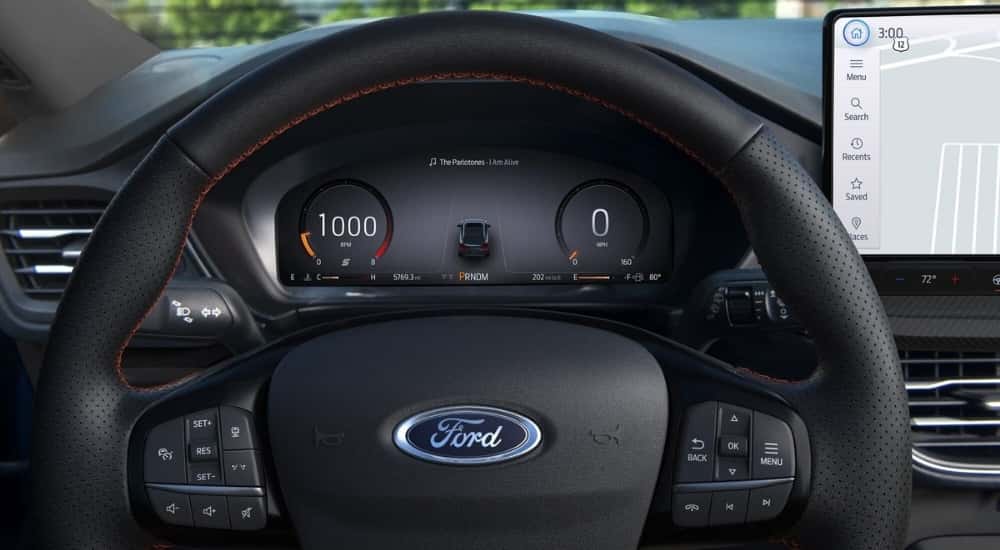
Ford skyrockets the Escape’s appeal with its hybrid powertrain, giving Monroe drivers the opportunity to save more on fuel without requiring them to adopt an all-electric lifestyle. As a hybrid, the 2025 Escape relies on a 2.5L inline-four hybrid powertrain to produce 192 hp. The Escape’s regenerative braking system works behind the scenes to recharge the battery as you drive, leaving your focus on keeping fuel in the tank.
Fortunately, stopping for fuel doesn’t mean spending a fortune. The 2025 Escape HEV averages an EPA-estimated 39 MPG combined as a front-wheel drive SUV, which breaks down to 42 MPG in the city and 36 MPG on the highway. Opting for all-wheel drive doesn’t alter this average, delivering all-season confidence without compromising the SUV’s efficiency.
How It Compares
Few automakers have leveraged hybrid capability in the compact SUV segment, making the Escape one of only a few to offer an alternative to a traditional gas powertrain. You won’t find a hybrid option for GM SUVs like the Chevy Equinox, GMC Terrain, or Buick Envista and Envision. Nor will you see a hybrid powertrain under the hood of the Mazda CX-5, Mitsubishi Eclipse Cross, Nissan Rogue, or Volkswagen Tiguan in 2025.
The Efficient Plug-In: The 2025 Escape’s PHEV
The 2025 Escape PHEV appeals to Monroe drivers who are ready for something more than a traditional hybrid. Ford equips the Escape PHEV with a 2.5L inline-four hybrid engine with a 14.4 kWh battery for a combined output of 210 hp.
As a plug-in hybrid, the Escape PHEV operates on gas and electricity, giving drivers a unique advantage. Recharging the battery is straightforward and can be done with a regular, 120-volt home outlet. However, if you forget to charge the battery, the Escape PHEV still runs on fuel. This is advantageous and explains the Escape PHEV’s EPA-estimated fuel economy of 40 MPG combined, 101 MPGe, and its all-electric range of 37 miles.
How It Compares: Hyundai Tucson
The 2025 Escape PHEV is more efficient than rivals like the Hyundai Tucson. The 2025 Tucson PHEV relies on a 1.6L turbocharged inline-four and a 13.8 kWh battery. The smaller-capacity engine and battery don’t make the Tucson more efficient, as the SUV offers an EPA-estimated fuel economy of 35 MPG combined, 77 MPGe, and a 32-mile all-electric range.
How It Compares: Kia Sportage
Kia’s 2025 Sportage is another rival in the segment that showcases the Escape PHEV’s ingenuity and efficiency. The Sportage PHEV relies on a 1.6L turbocharged inline-four and 13.8 kWh battery, the same setup as the Tucson. Yet, the Sportage isn’t as efficient as its Hyundai cousin, with the plug-in hybrid averaging an EPA-estimated 35 MPG combined, 84 MPGe, and a 34-mile electric range.
Striking the Perfect Balance
The 2025 Escape hits the sweet spot, balancing efficiency, space, and affordability with its value-rich packaging. Its multi-engine lineup offers something for every driver, whether you’re looking for Ford’s proven gas powertrain, a hybrid, or a plug-in hybrid that delivers the best of both worlds. The opportunities for an exciting experience behind the wheel are plentiful, and the features are rich.
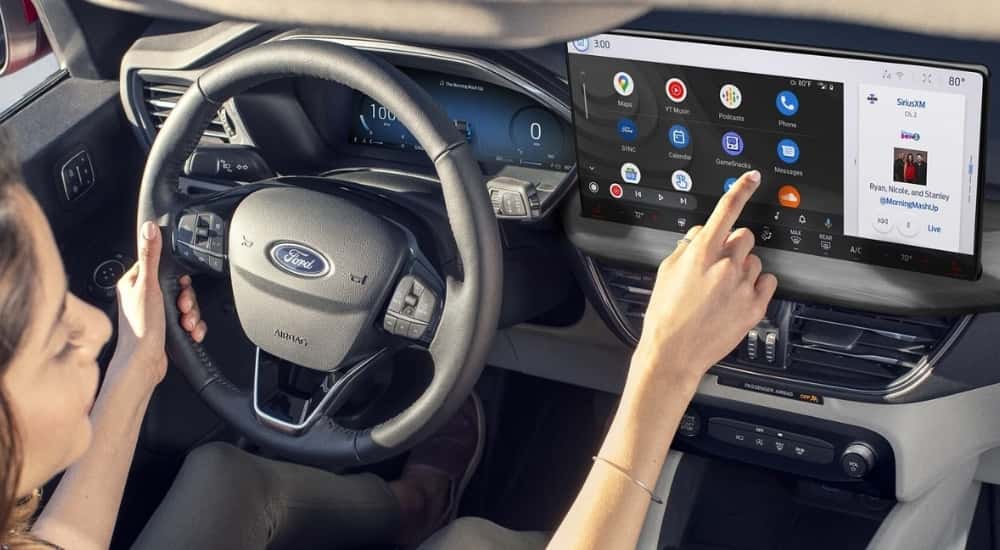
The 2025 Escape’s starting price of $29,515 makes it one of the most affordable in the segment.[a] It’s a perfect complement to its efficient performance, especially when you consider everything you get with your investment. The versatile crossover offers everything from advanced driver-assist technologies like Ford’s Blind Spot Information System with Rear Cross-Traffic Braking to an expansive 13.2-inch center touchscreen, heated front row seats, and a power liftgate.
So, how will the 2025 Escape add to your experience on the road? There’s no question that it’s engineered to defy expectations with its engaging and efficient performance and exceptional value.
0 comment(s) so far on 2025 Ford Escape vs Rivals: How Efficient is Ford’s Compact SUV?