Understanding the Different Types of Transmissions

Of course, we offer transmission repair near Snellville, but we recognize that most consumers don’t really know what a transmission is, how it works, or the various types. And why should you? Understanding the mechanisms of cars is really the job of our technicians; your job is to simply enjoy a reliable, powerful vehicle.
Still, when you’re looking for a vehicle, you will find that different models have different types of transmissions, and you might even have several choices of transmissions for a model. The transmission you choose will impact how you experience your vehicle, from its fuel efficiency to its performance to how it feels to drive. It could also affect price, both on the day you buy and when it comes time for routine maintenance.
We always want our customers to be armed with information to make the right choice for their needs. With this in mind, we’ve created a clear breakdown of the different transmission types. But first, let’s explain what a transmission is…
What Exactly Is a Transmission?
A transmission can best be explained as the connection between your car’s engine and its wheels. It converts the power from the engine into usable power for your vehicle, and it has to decide exactly how much power is needed during select maneuvers. Your transmission moves between larger and smaller gears, which impacts momentum at various speeds. It plays a part in speeding up as well as slowing down.
Think of it like this: You know how, when you’re riding a bike, you change to lower gears when you’re going uphill, so you can experience less resistance when pedaling? And you might switch to higher gears when going downhill, to better control your speed? Your transmission works a lot like that.
The type of transmission you choose will determine how power is transferred from your engine to your gears. The main types of transmissions are manual, automatic, continuously variable, and dual-clutch; in the following, we’ll explain how each one works…
Manual Transmissions
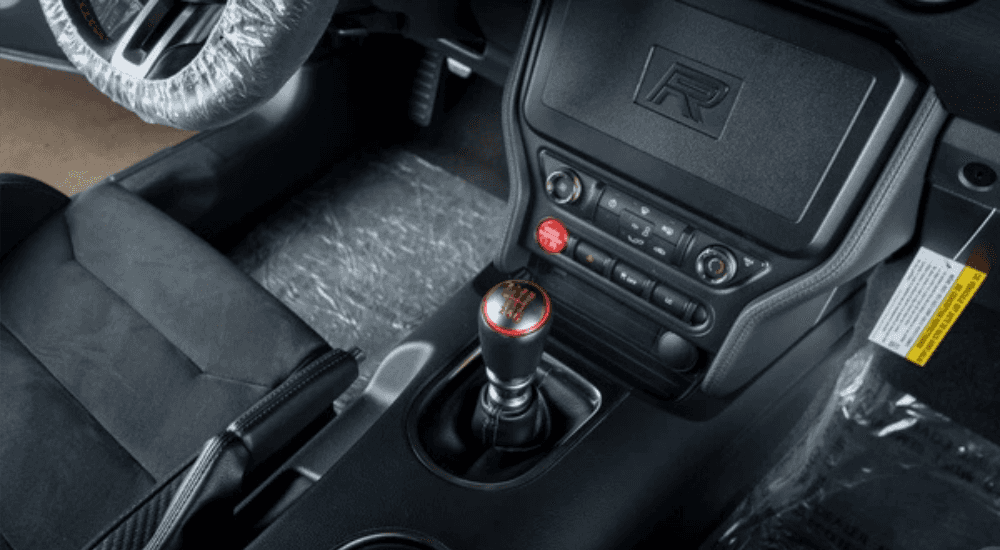
A manual transmission (often called a “stick shift”) is, as its name implies, pretty hands-on. You’ll need to physically move a shift knob (also called a “gear knob” or, colloquially, a “shifter”) into the correct gear.
You’ve probably encountered the question “Do you know how to drive a stick?” when renting a car in another country or driving a buddy’s vintage vehicle. That’s because stick shifts have become increasingly less popular in the US compared to automatic transmissions. Thus, when one shows up, it’s rarely assumed that a driver knows how to use one. Some say that knowing how to drive a stick shift will soon become a lost art.
So, why do some people still choose manual transmissions? Those who truly love the act of driving often desire a more hands-on feel, and a manual transmission gives them that. Plus, manual transmissions usually cost less to repair, thanks to their simpler designs. Manual transmissions tend to have five or six forward gears, as well as one reverse gear, although some can have as many as seven gears.
Depending on who you ask (and how old the car is), some say manual transmissions aren’t as efficient as automatic transmissions. This is due in part to the fact that automatic transmissions tend to have more gears, allowing a vehicle to operate at its most efficient revolutions per minute (RPMs) than a manual.
Pros: Hands-on feel; more affordable to repair.
Cons: Greater learning curve; can be less efficient than automatics.
Who It’s Right For: Driving enthusiasts who want a stronger feeling of connection with their car and the road.
Automatic Transmissions
Automatic transmissions determine the most appropriate gear on your behalf, so you won’t need to assess the situation and manually search for it on a gear knob. The vehicle relies on sensors and a computer to determine whether you currently need a gear that delivers more power or more efficiency, so all you need to do is focus on steering.
Your automatic transmission will select a lower gear to improve momentum when you need to accelerate, for example. Then it will move into a higher one when you’re at cruising speed to give your engine a break and boost efficiency. Most automatic transmissions have somewhere between five and eight gears.
Some really smart automatic transmissions learn your driving behaviors and adapt to them. They might learn whether you like to drive fast or take it easy, getting better at choosing the best gear for your patterns.
Pros: No learning curve; readily available.
Cons: Can be pricier than manuals.
Who It’s Right For: Someone looking for easy performance.
Continuously Variable Transmissions
So far, we’ve talked a lot about vehicles that require you to manually choose a gear versus those that choose the right gear for you. A continuously variable transmission (CVT) ditches all of that language of moving from first gear to third gear and so on. Instead, it essentially offers infinite gears—but how?
Put simply, CVTs rely on belts and pulleys, converting simple machine components into something of a modern marvel. These belts and pulleys can change their size and position without increments, ensuring your vehicle is always in the best gear ratio, which allows for ultra-smooth acceleration and the best possible efficiency.
Pros: Great fuel efficiency; a smooth ride.
Cons: Can be more expensive to repair; some drivers don’t like the “drone” sound of the belt cycling around the pulleys.
Who It’s Right For: Drivers who prioritize comfort and efficiency (such as commuters).
Dual Clutch Transmissions
You can think of a dual clutch transmission like two manual transmissions working together. One clutch contains the odd-numbered gears and the other controls the even-numbered gears.
However, dual clutch transmissions don’t meet the description of a pure automatic or a manual transmission. Instead, they’re seeing a bit of both, as an “automated manual transmission.” It has clutches and gears, similar to a manual, but internal systems handle choosing the gears for you, like an automatic.
With dual clutch transmissions, the system is sort of “queuing up” the next appropriate gear, having it ready just in time for the moment you change gears. This is why dual clutch transmissions are known for ultra-smooth gear shifts.
Pros: Smooth, sporty feel; solid efficiency.
Cons: Maintenance can be pricey; some say it’s “jerky” at lower speeds.
Who It’s Right For: Performance enthusiasts who like a sporty feel.
Get Top-Shelf Transmission Service With Us
No matter which transmission type makes the most sense for your Snellville life, we’re here to keep yours running at its best. From the user-friendly automatic and ultra-efficient CVT to the hands-on manual and blended dual clutch, we know how to maintain every type of transmission here at our service department.
Our service experts know the correct maintenance schedule for the various transmission types, as well as the most common issues to look for. We can even give you tips on best practices for prolonging the lifespan of your transmission. Whether you’re hitting the track, managing a carpool, or commuting on the highway, there’s a transmission that’s right for you, and there’s a technician here who can maintain it.
We’re excited to guide you in your shopping journey and then provide you with quality auto care in the years that follow. Visit us today for end-to-end support, from shopping to servicing!
0 comment(s) so far on Understanding the Different Types of Transmissions